
TV Wall Mounting in Anaheim
TV Mounting Works Anaheim covers the most common job in Anaheim homes, plain TV wall mounting with a flat or tilting bracket — a living room in a West Anaheim ranch house, a primary bedroom in a 1980s two-story up in the hills, a den in a newer townhome — with the bracket bolted into framing, the screen lined up with the seats and the cords brought neatly down to the outlet.
Bookings aren't open yet. Leave your name and number; your message is recorded, and you'll get one message when a local installer is available.
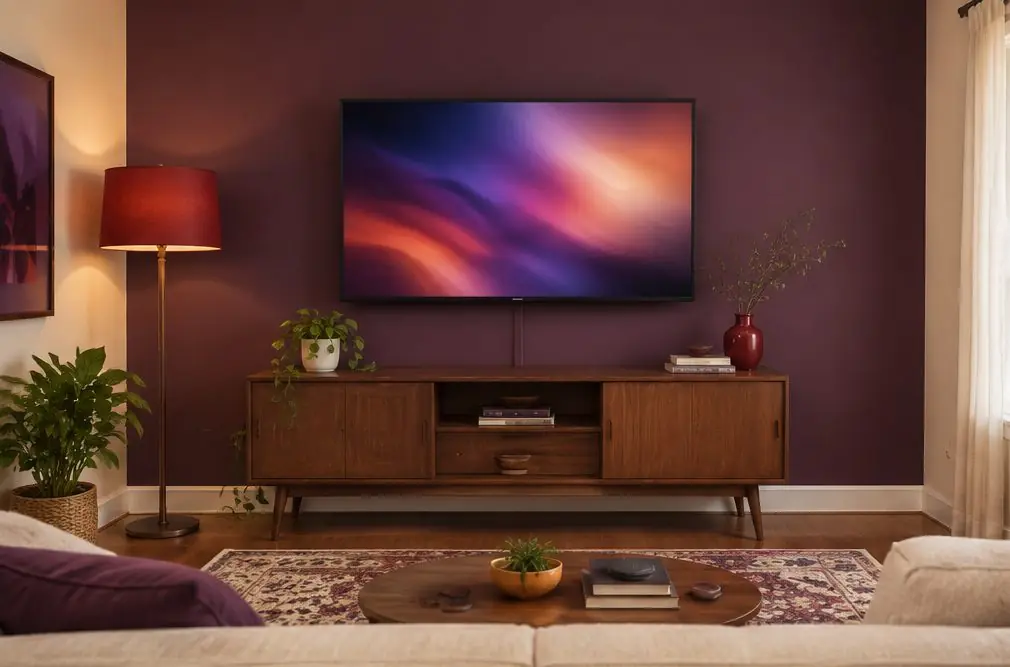 Illustration
TV Wall Mounting in Anaheim, CA typically runs $99–$419 per TV in our 2027 estimator, depending on the TV size and the wall type. Use the estimator below for your own numbers.
Bolting the plate into the framing
A drywall install on wood framing is the baseline every other price on this site builds on. It usually goes like this:
- Weigh up the TV: its weight and the four-hole VESA pattern on the back pick the bracket, and the bracket's rating should be at least one and a half times what it carries.
- Tape it out: a paper or tape outline of the screen goes on the wall first, and the household looks at it from where they actually sit.
- Find wood: a stud finder gives a first guess, and a tiny test hole hidden under the plate's footprint proves it.
- Fasten: the plate gets pilot holes on each stud's center line and 5/16-inch lag bolts tightened until it bears flat on the wall.
- Load and re-level: with the TV hooked on, the level is checked again, because a plate can settle a hair once the weight is on it.
- Finish: safety screws go in under the brackets, cords are bundled to the outlet, and the tilt is demonstrated.
| Room | Bracket that usually fits | Why |
|---|---|---|
| Living room, sofa facing the wall | Flat (fixed) | Thinnest look, screen already at seated height |
| Bedroom with a tall dresser | Tilting | Screen rides higher, tilt aims it at the pillows |
| Wall with a deep baseboard or a box behind the TV | Flat with a deeper spacer | Keeps the screen from rocking on the obstruction |
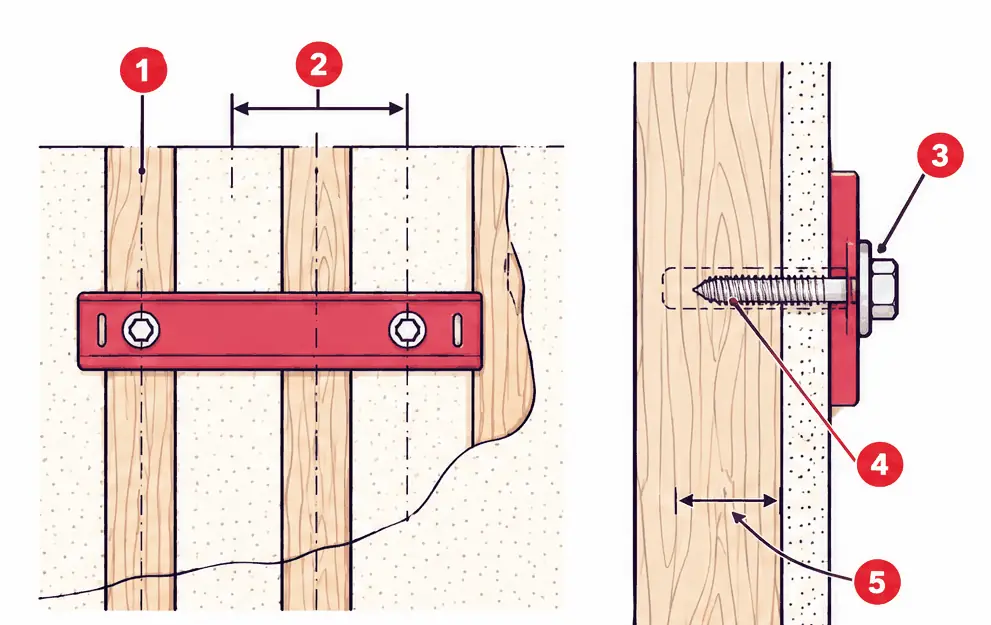
What the numbers show
- Stud center line A finder and a small test hole locate the middle of the stud, and the bolt goes in right on that line.
- Stud spacing With framing at roughly 16 inches on center, a wide plate can catch two studs at once.
- Washer and head The washer under the hex head clamps the plate evenly instead of at one point.
- Threads in solid wood The threaded part grips the core of the stud and stops short of its far side.
- Depth into the stud Most of the bolt's length sits in wood, well past the half inch of drywall.
Choosing the wall in a sunny Anaheim room
Inland Anaheim gets long, bright afternoons, and many postwar tract houses have a big picture window on the front or the west side. A screen hung opposite that glass turns into a mirror by four o'clock. The wall at a right angle to the window is usually the better choice, even if it means moving a bookcase.
The other contender in many family rooms is the fireplace wall. That is a separate job with its own page, because brick and stone change the fasteners and the heat changes the height.
Eye level, measured from the seat
Nobody judges height well standing up. The installer takes a seat in the usual spot, marks where the eyes fall and centers the screen on that mark. When the TV must sit higher, over a dresser in a bedroom for example, a tilting bracket leans the top a few degrees forward so the picture still faces the viewer.
Framing rarely cooperates with the center of the room: Anaheim houses are framed at about 16 inches on center, so a wide plate spans two studs and a sliding adapter can nudge the screen sideways a few inches to land dead center on the sofa.
Good height is the one the household stops thinking about after a week.
Hollow spots between studs
Sometimes the ideal spot has hollow drywall behind it: framing moved during a remodel, a doorway right beside the screen, or a wall centered between two windows. Studs still carry the weight wherever they can reach the plate, and anchors only help hold the rest steady.
- Toggle bolts with a steel channel go in through a small hole, then sit flat against the back of the drywall so the pull is shared along a wide strip.
- Ratings are checked against the actual load: TV plus bracket, compared with the anchor maker's figure for half-inch drywall, with plenty of margin left over.
- One stud, one toggle side is a common compromise: lag bolts where a stud is, toggles on the opposite end of the plate.
- Articulating arms and very big screens never rely on hollow-wall anchors; they need studs or a wood backer.
TV Wall Mounting — common questions
What does a 65-inch TV on a regular wall run in Anaheim?
On drywall over wood studs, a 50–65 inch TV typically runs $119–$169 in 2027, and a 66–85 inch TV $149–$219. A 32–49 inch screen is about $99–$139.
Will a bracket bought online work?
Usually, as long as its weight rating and VESA pattern match the TV; the installer checks both before drilling. If the bracket is supplied instead, that adds $45–$135 depending on type and size.
Availability & price range
TV Wall Mounting: check availability and price range
Bookings aren't open yet — answer a few quick questions about the TV and the wall and get a typical Anaheim price range right here. Typical Anaheim prices for one TV, labor only unless an option says otherwise. This is a market estimate, not a quote.