
TV Mounting Works Anaheim: In-Wall Wire Concealment in Anaheim
TV Mounting Works Anaheim covers hiding TV wires inside the walls of Anaheim homes — an in-wall rated power kit and HDMI pass-through on drywall with an open stud bay, and a painted surface raceway on plaster, stone and any wall that cannot be opened.
Bookings aren't open yet. Leave your name and number; your message is recorded, and you'll get one message when a local installer is available.
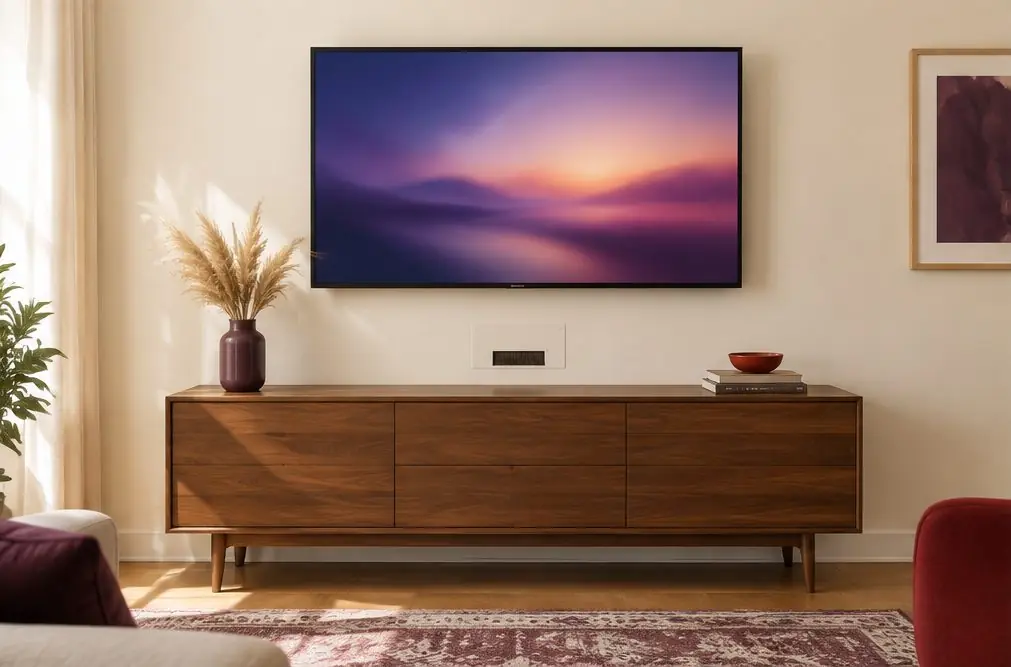 Illustration
Why a power cord never goes inside the wall
A normal cord is not rated for in-wall use and can overheat or be damaged by a nail or screw, with no way to see the problem. Rated kits solve this with a proper cable and boxes. That is the line between hiding wires and creating a hazard.
How the kit is installed
- The stud bay is checked for fire blocking, wires and pipes with a camera or probe hole.
- An upper recessed box is cut into the drywall behind the TV and a lower inlet box near the outlet.
- Rated cable connects them inside the bay, and low-voltage cables follow the same route.
- A short cord plugs the lower box into the existing outlet; the TV plugs into the upper box.
| Part | Where | Role |
|---|---|---|
| Upper recessed box | Behind the TV | Receptacle and cable pass-through |
| Rated in-wall cable | In the stud bay | Carries power safely |
| Lower inlet box | Near the outlet | Takes power from an existing outlet |
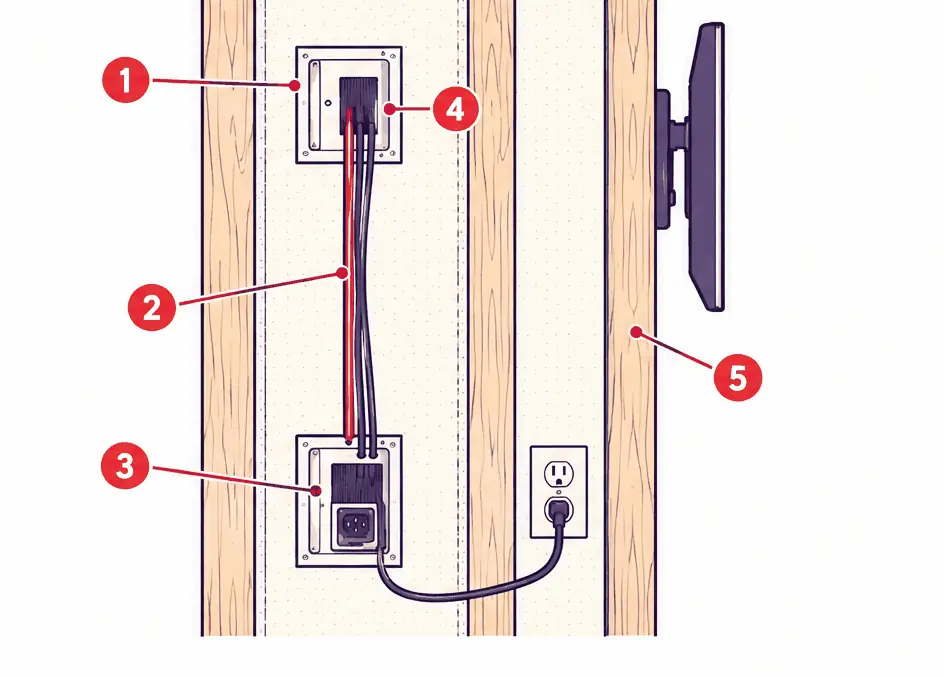
What the numbers show
- Upper recessed box A recessed box behind the TV holds the receptacle the TV plugs into.
- In-wall rated cable Rated cable runs between the boxes inside the stud bay.
- Lower inlet box A recessed box near the floor takes power from a short cord to an existing outlet.
- Signal pass-through A brush-covered opening lets HDMI cables pass through the same bay.
- Stud bay The bay between two studs is the protected route for the cable.
When the wall cannot be opened
Plaster, stone, brick and shared condo walls are often better left alone. A slim raceway fixed to the surface, painted to match, holds the cables in a straight vertical run, and a console or cabinet directly below the TV shortens the visible run.
Hiding wires is a matter of choosing the route, not forcing the wall.
In-Wall Wire Concealment — common questions
How much does hiding the wires cost?
About $95–$165 per run in 2026 on drywall with an open stud bay.
Can an extension cord go in the wall?
No. Only an in-wall rated kit carries power inside a wall.
Availability & price range
In-Wall Wire Concealment: check availability and price range
Bookings aren't open yet — answer a few quick questions about the TV and the wall and get a typical Anaheim price range right here. Typical Anaheim prices for one TV, labor only unless an option says otherwise. This is a market estimate, not a quote.